
Rules of Continuing Professional Education

General Rules of the Continuing Professional Education System
Introduction
As a result of the rapid development in information systems, both locally and internationally, as well as the growth in the volume of dealings between countries under trade facilitation agreements—which has been greatly reflected in multinational companies—reliance on financial data and the reports issued from it has increased significantly. This has been reflected in the importance of the role of the chartered accountant and auditor and the impact of their level of performance on the economy in general, both locally and internationally.
From this standpoint, and within the framework of the Society's continuous endeavor to develop and build the skills of the Society's members and fellows and to raise their scientific and professional level, the Society's Board of Directors decided to apply the Continuing Professional Education system, in line with international rules and standards in this regard. It was decided that the application of the Continuing Professional Education system to the Society's members and fellows would begin as of 1 January 2009.
First: Definitions
The following terms are used in the General Rules of the Continuing Professional Education system with the meaning stated alongside each:
- a. The Society: the Egyptian Society of Accountants & Auditors (ESAA).
- b. The Committee: the Continuing Professional Education Committee.
- c. The Members: this includes the members and fellows of the Egyptian Society of Accountants & Auditors (ESAA).
- d. The Profession: the profession of accounting and auditing.
- e. Continuing Professional Education programs: the programs that contribute to increasing the member's competence and are considered essential to professional work and to maintaining other professional skills.
- f. Date of acquiring membership: the date of the Society's Board of Directors' approval of the membership.
- g. Hours of participation in delivering Continuing Professional Education program training: these include the hours of preparing, presenting, and delivering Continuing Professional Education programs.
Second: The Objective of the Continuing Professional Education System
- Raising the level of competence of those practicing the profession.
- Updating their information in a manner commensurate with the constant development, change, and updating of both accounting and auditing standards and the international and local requirements related to the profession.
Third: Those to Whom the System Applies
- All members of the Society are required to obtain 120 professional education hours over a period of three calendar years, with a minimum of 25 hours annually and a maximum of 55 hours annually; a reinstated member is bound by the prescribed limit.
- A new member is exempted from the minimum number of hours in the period completing the first calendar year from the date of acquiring membership, provided that they comply with the hours stipulated in the system beginning from the calendar year following the date of acquiring membership in the Society.
- Retired members / fellows who do not practice the profession of accounting and auditing are exempted from compliance with the Continuing Professional Education hours stipulated in the system.
Fourth: Scope of Continuing Professional Education Programs
Members required to undertake Continuing Professional Education have available to them a wide range of topics when choosing the Continuing Professional Education program that suits their professional activities. The basic principle is that all programs that contribute to increasing the member's competence in the topics of accounting, auditing, taxation, information technology, professional consulting, and what is considered essential to professional work can be accepted as part of these programs. Programs that contribute to developing and maintaining other professional skills—such as programs to develop presentation and communication skills, management and leadership skills, and cognitive skills—can also be considered acceptable programs for Continuing Professional Education.
Fifth: Those subject to the Continuing Professional Education system are required to do the following:
- Notify the Society of their fulfillment of the conditions of the Continuing Professional Education system annually, within six months from the end date of the calendar year and in accordance with the attached form.
- Submit a detailed statement to the Society regarding the scientific and training material they have obtained, and the Society has the right to assess the appropriate training hours if necessary.
- The supporting evidence for what has been recorded in the form shall be, for example, as follows:
a. The document issued by the organizing entity (conferences, seminars, and Continuing Professional Education programs).
- b. The document assigning the preparation and execution of the training work from the beneficiary / executing entity (training work).
- c. The publication approval document (scientific research work, articles, books, and working papers related to professional work).
Sixth: Monitoring Compliance
The Society's administration verifies compliance with the requirements of the Continuing Professional Education program through specific controls approved by the Continuing Professional Education Committee.
Seventh: Temporary Suspension
- Temporary suspension (with a minimum of 6 months per year) from complying with the requirements of the Continuing Professional Education program is permitted if it is not possible to fulfill those requirements within the specified period for acceptable reasons, provided that a request to that effect is submitted to the Society's Continuing Professional Education Committee.
- The Committee has discretion over the extent of accepting or rejecting the suspension according to the nature of the reasons for the temporary suspension. Among the justifiable reasons for temporary suspension are, for example, the following:
**a. Health condition:
**The request must include the nature of the illness, the name and address of the treating entity, and the reason that makes the illness an impediment to fulfilling the requirements of Continuing Professional Education courses.
- **b. Other similar reasons:
**The request must include a full explanation of the nature of the reasons that prevented the fulfillment of the Continuing Professional Education requirements.
Eighth: Non-Compliance with the Continuing Professional Education System
In the event that a member / fellow of the Society does not comply with the minimum Continuing Professional Education hours stipulated in the Continuing Professional Education system, the Society's Board of Directors has the right, pursuant to Article (19) paragraph (3) of the Society's Statutes, to warn the member, or suspend them for a period of not less than six months, or strike them off.
Ninth: Measuring Continuing Professional Education Hours
- In all cases, the number of direct professional education hours must not be less than 60% (72 hours) of the Continuing Professional Education hours, and the indirect professional education hours shall be within 40% (48 hours) at most.
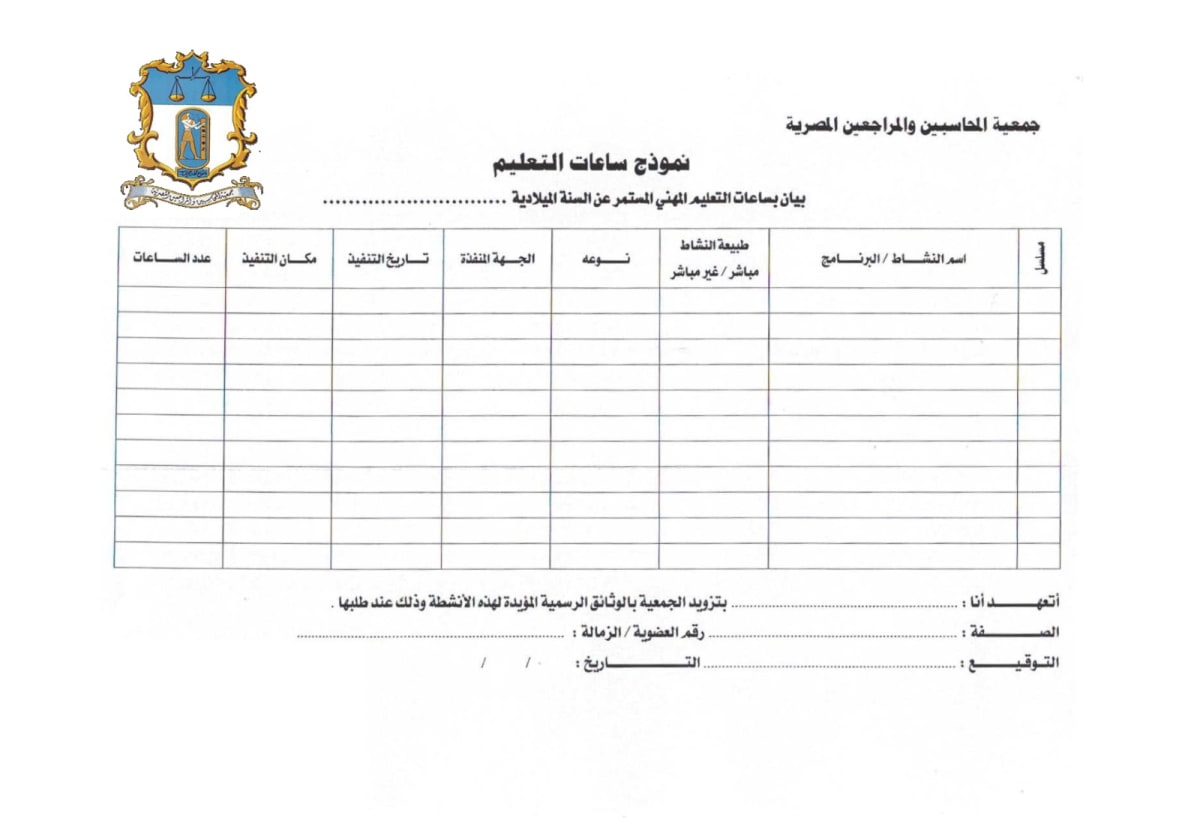
Download the Continuing Professional Education form
