A Global Tax: Pillar Two for Achieving Tax Justice
Pilar 2 The OECD's efforts to achieve tax justice
Pillar Two ...................... The OECD's efforts to achieve tax justice and their impact on the International Accounting Standard on Income Taxes (IAS 12)
The Organisation for Economic Co-operation and Development (OECD) issued the Pillar Two model in December 2021, which aims to address the challenges arising from the digitalization of the economy and was agreed upon by more than 135 countries representing 90% of global output. The goal is to achieve a degree of tax justice for developing countries in which multinational companies operate, by setting a minimum tax that companies are obliged to pay to the countries in which they operate on the revenues they generate from those countries. This minimum represents 15% of the profits companies generate in those countries. Pillar Two has limited its scope of application to multinational companies, clarifying that it applies only to companies whose total consolidated annual revenues exceed EUR 750 million. The Pillar includes four rules to achieve tax justice, as follows:
- The Subject to Tax Rule, through which an interest rate of no less than 9% is calculated for transactions with related parties that do not include interest charged on them.
- The Qualified Domestic Minimum Top-up Tax rule (QDMTT).
- The Income Inclusion Rule (IIR).
- The Under Taxed Payment Rule (UTPR).
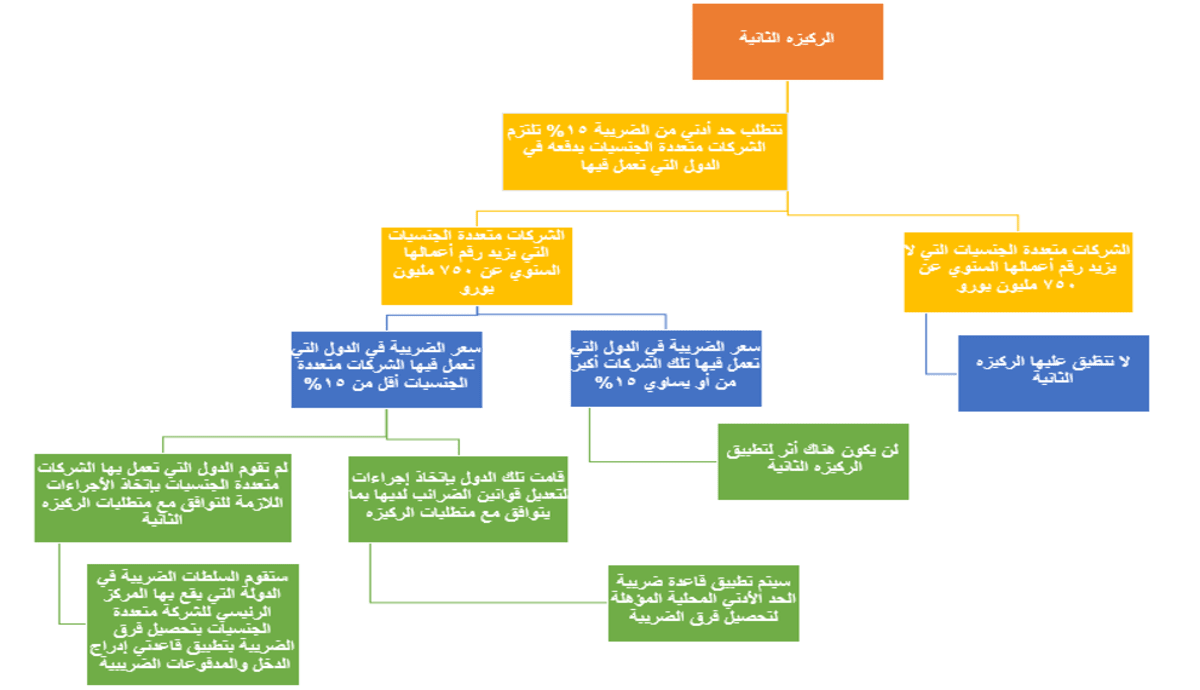
The steps through which the last three rules will be applied to multinational companies subject to Pillar Two
- Comparing the effective tax rate paid on revenues generated from each country in which the group operates with the minimum tax established by Pillar Two, which is 15% of net accounting profit. 2. If the effective tax rate paid (the effective tax rate) in each country is greater than or equal to the minimum tax (15%), then there will be no impact from applying Pillar Two; but if the tax rate paid is less than the minimum tax (15%), then we move to the third step. 3. If the minimum tax (15%) required by Pillar Two exceeds the tax paid (the effective tax rate) in all or some of the countries in which the group conducts its activity, then in this case the tax authorities in each of those countries will collect a tax called Top-up Tax through the Qualified Domestic Minimum Top-up Tax rule (QDMTT). 4. If the tax authorities in any of the countries in which the group operates do not apply Pillar Two, then in this case the tax authorities in the country in which the parent company conducts its activity will be obliged to collect the difference between the tax rate paid in a given country and the minimum tax required by Pillar Two, either through the Income Inclusion Rule (IIR) — which is an accounting method by which an additional tax is imposed on multinational companies in the country where the parent company conducts its activity so that payment of the due tax difference is reached within the taxes paid to the country where the parent company conducts its activity. If the tax authorities are unable to apply the Income Inclusion Rule (IIR), the tax difference is collected through the Under Taxed Payment Rule (UTPR), by which certain deductions are excluded from the tax base of the multinational company, or any additional measures are taken to ensure the required ratio is achieved.
Applying Pillar Two requires the tax authorities in each country to amend their tax laws in line with the requirements of Pillar Two. So far, only two countries in the Middle East have begun taking measures to apply the requirements of Pillar Two: Qatar and the United Arab Emirates. As for the Arab Republic of Egypt, those in charge of taxation are required to take the necessary measures to amend the income tax law in line with the requirements of Pillar Two, given the benefits this will bring to the economy. Although the corporate income tax rate in Egypt is 22.5%, which is higher than the minimum tax required by Pillar Two (15%), there are some multinational companies operating in free zones subject to income tax at a rate of 0%, as well as companies operating in special-nature economic zones subject to tax at a rate of 10%.
Amending the International Accounting Standard on Income Taxes (IAS 12) in line with the Pillar's requirements ....
On 23 May 2023, the International Accounting Standards Board issued the model International Tax Reform – Pillar Two Disclosures, through which International Accounting Standard No. 12 on Income Taxes was amended, with the aim of:
- Providing timely support for companies that will be affected by applying Pillar Two.
- Avoiding differing interpretations of how to apply the requirements of Pillar Two.
- Improving the quality of information provided to users of financial statements before and after applying Pillar Two.
The aforementioned amendments to the standard stipulated a necessary and temporary exemption from the impact of applying Pillar Two on companies' deferred tax assets and liabilities, both in terms of recognition and disclosure of that impact, with the requirement that those companies disclose in their annual financial statements for periods beginning on or after 1 January 2023 their application of that necessary temporary exemption required by the standard.
The amendments did not include a requirement to disclose the impact of applying Pillar Two on interim financial statements for periods ending on or before 31 December 2023.
The amendments included a requirement for companies to disclose other quantitative and qualitative information affecting the financial statements, other than that related to deferred taxes and arising from applying the requirements of Pillar Two, for annual financial statements for periods beginning on or after 1 January 2023. That information which the standard amendments require to be disclosed includes the impact of applying Pillar Two on companies' current tax expense, as well as disclosure of cases in which tax laws are amended in some of the countries in which the multinational group operates but have not yet come into effect as of the date of preparing those companies' financial statements, so that users of those companies' financial statements can assess their decisions and evaluate the future impact of applying the requirements of Pillar Two. It should be noted that these disclosures are necessary only when the company makes profits in the periods in which the Pillar Two amendments are applied.
Companies subject to the requirements of Pillar Two, when disclosing the impact of those requirements on income taxes, must carefully clarify the effective tax rate on the basis of which it is measured whether a Top-up tax will be paid or not — in the event that the minimum tax required by the Pillar (15%) is higher than that effective tax rate — and must disclose the method of its calculation, where the effective tax rate = income tax expense / net accounting profit before tax.
It should be noted that when the International Accounting Standards Board issued the amendments, it did not provide additional information enabling companies to determine when the additional taxes resulting from applying the requirements of Pillar Two may be considered income taxes subject to International Accounting Standard No. 12 on Income Taxes, nor did it require companies to treat them as income taxes. Therefore, it left it to companies' judgment to determine whether those additional taxes are income taxes subject to Standard No. 12 based on certain considerations or not. If the company concludes that those taxes are outside Standard No. 12, it must disclose this in the financial statements, along with the reasons for which it considered those taxes outside the standard and the method of their presentation in the financial statements.
There may be no tax impact from applying the requirements of Pillar Two for a multinational group operating in countries that apply an income tax rate greater than or equal to 15%; in this case those companies must disclose this in their consolidated financial statements. The tax impact may also be relatively small for companies operating in countries that apply a tax rate of less than 15% but very close to that rate, such that the differences arising from applying the requirements of Pillar Two are not material; in this case too, those companies must disclose this.
If companies are unable to provide sufficient and reliable information in the notes to the financial statements about the tax impact of applying the requirements of Pillar Two, then in this case those companies must disclose this in their financial statements.
Finally, if Pillar Two does not apply to a particular group of companies because the total consolidated annual revenues of those companies are less than or equal to EUR 750 million, then those companies must disclose this in their financial statements.
As for Egypt, it will be necessary to amend Egyptian Accounting Standard No. 24 on Income Taxes in line with the amendments to the International Accounting Standard on Income Taxes (IAS 24).
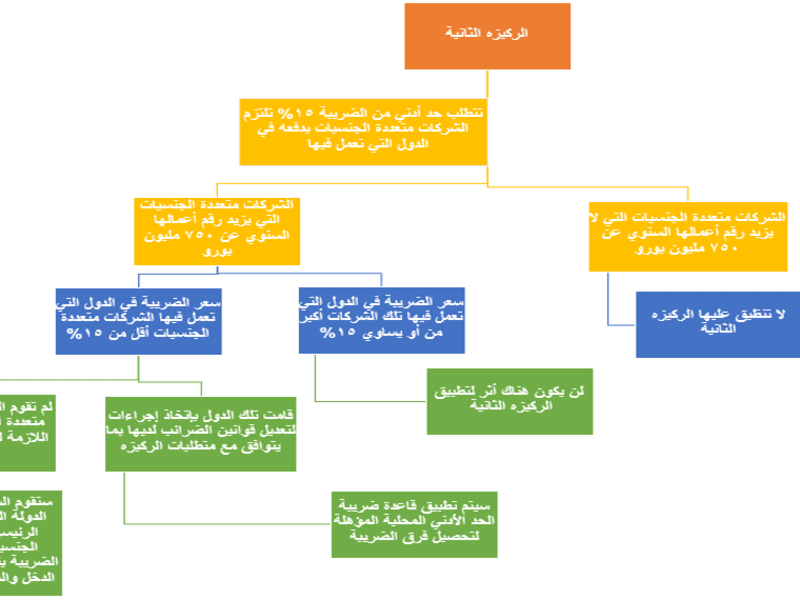
The following is an illustration of how Pillar Two works .......